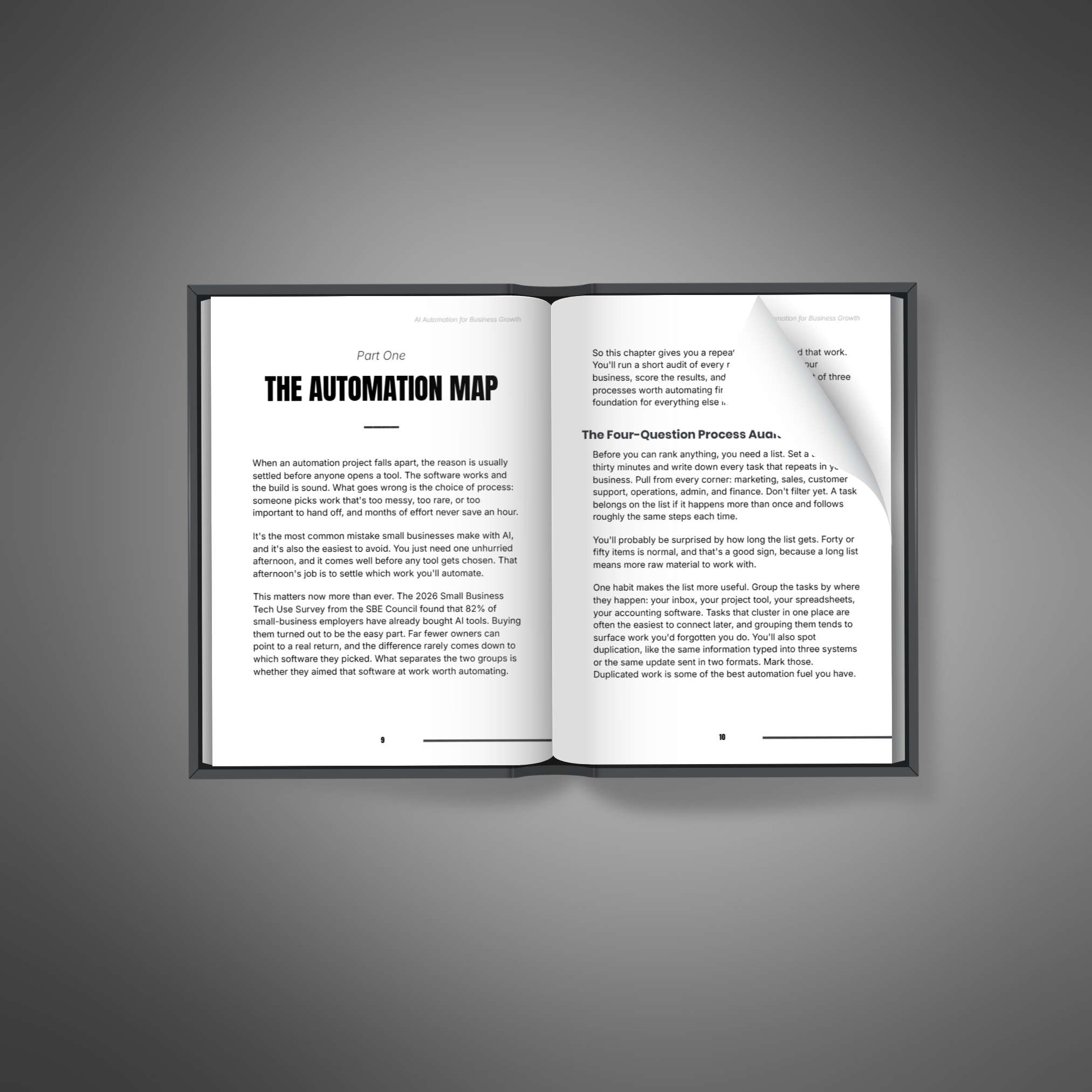
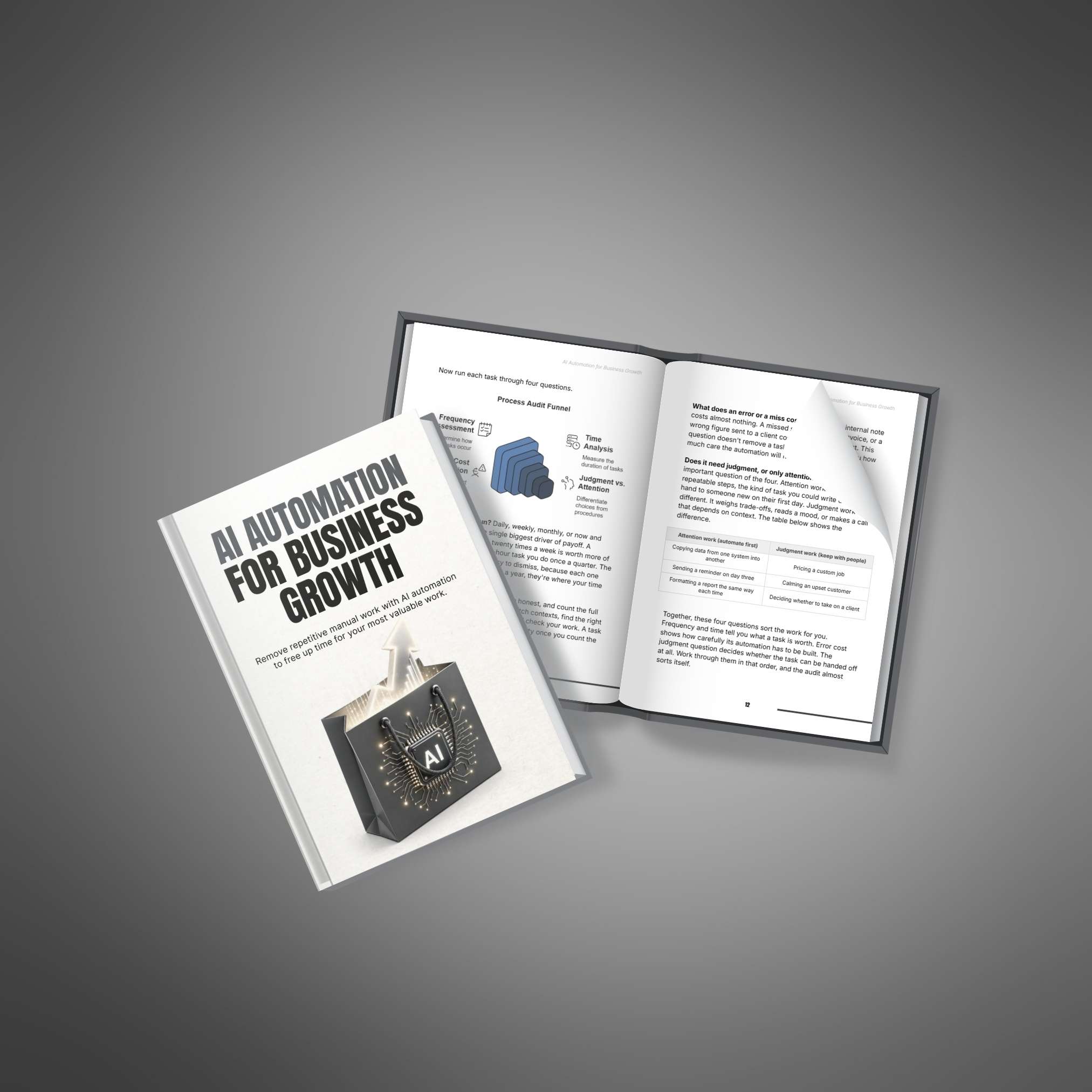
AI Automation for Business Growth is a practical book about turning isolated AI experiments into workflows that serve a clear business purpose. Its starting point is the work itself: what repeats, where effort is being spent and which improvement would be worth maintaining. That helps frame automation as an operational decision rather than a collection of fashionable tools.
The book combines a task audit, a three-layer stack, a six-step workflow method and a way to review value over time. It also addresses error handling, because a workflow needs to cope with real inputs rather than only a successful demonstration. The approach is aimed at readers who want to work without writing code, while still thinking carefully about reliability and return.
What you will learn
- Rank repeating tasks: Use potential payoff to compare possible automation projects before committing to a tool or building a complicated sequence.
- Keep the stack lean: Understand the role of the proposed three-layer structure and consider which tools are actually needed for the workflow.
- Build with a method: Follow a six-step perspective that connects the chosen task with the design and operation of an automated process.
- Account for exceptions: Consider error handling as part of the workflow rather than assuming every incoming request or piece of information will be predictable.
- Review operational value: Use a workflow scoreboard to examine time and money implications instead of judging success only by whether a process runs.
- Sequence future improvements: Apply the 90-day planning framework when deciding what to build next and when an existing workflow needs attention.
Who this ebook is for
This book is for small-business owners, entrepreneurs and operators who want a more disciplined approach to no-code AI automation. It is useful if you have repetitive work to address but need help choosing a sensible first project. Readers with a working automation can also use its themes to reassess whether that process is reliable, useful and proportionate to its upkeep.
Put the ideas into practice
Choose a recurring activity with a clear starting point and a result you can inspect. Write down what happens when information is missing or incorrect, not just the ideal sequence. Use the book's method to develop a small workflow, then review it against your original goal. Treat claimed time savings as something to measure in your own setting. Current subscriptions, integrations and access permissions should be checked separately before adopting any third-party service.
Book details
Format: Ebook. Supplier-listed main book: 66 pages and 13,676 words.
Download availability: After payment, download the complete ZIP package or the included PDF separately.